
Your Mental Health Matters - We're Here to Help
Select a Psychotherapist and book an online session
Introduction: Finding Your Way Back to Yourself
Escaping a relationship defined by narcissistic abuse can feel like waking from a long, disorienting nightmare. The person you thought you knew, the reality you thought you shared, shatters, leaving behind a profound sense of confusion, loss, and deep emotional pain. You may question your sanity, your worth, and your ability to trust yourself or anyone else ever again. This experience leaves invisible wounds that run deeper than any physical scar, systematically dismantling your sense of self. But within this devastation lies the opportunity to reclaim the life that was taken from you.
The Invisible Wounds: Acknowledging Narcissistic Abuse
The first and most courageous step toward healing is acknowledging the reality of the abuse. Narcissistic Abuse is a pervasive pattern of emotional and psychological manipulation designed to control, demean, and disempower its victims. It is not a simple disagreement or a difficult relationship; it is a calculated erosion of your identity. Recognizing that what you endured was not your fault is the cornerstone of recovery. The gaslighting, the manipulation, and the constant criticism were tools used against you, not reflections of your character.
Your Journey to Healing, Clarity, and Peace
This guide is a roadmap for your journey back to yourself. Healing is not a linear path but a process of rediscovering your strength, rebuilding your self-worth, and forging a future defined by your own values and desires. It involves understanding the dynamics of the abuse, taking decisive steps to protect yourself, and consciously rebuilding your inner world. Peace is not just possible; it is your right. This journey is about reclaiming it, one step at a time.
Understanding the Landscape of Narcissistic Abuse
To heal from narcissistic abuse, you must first understand the terrain you have navigated. This form of abuse is insidious because it attacks your perception of reality, making it difficult to identify while you are experiencing it. Knowledge is power, and learning the abuser's playbook is the first step in disarming their influence over your life.
What is Narcissistic Abuse? Deconstructing the Experience
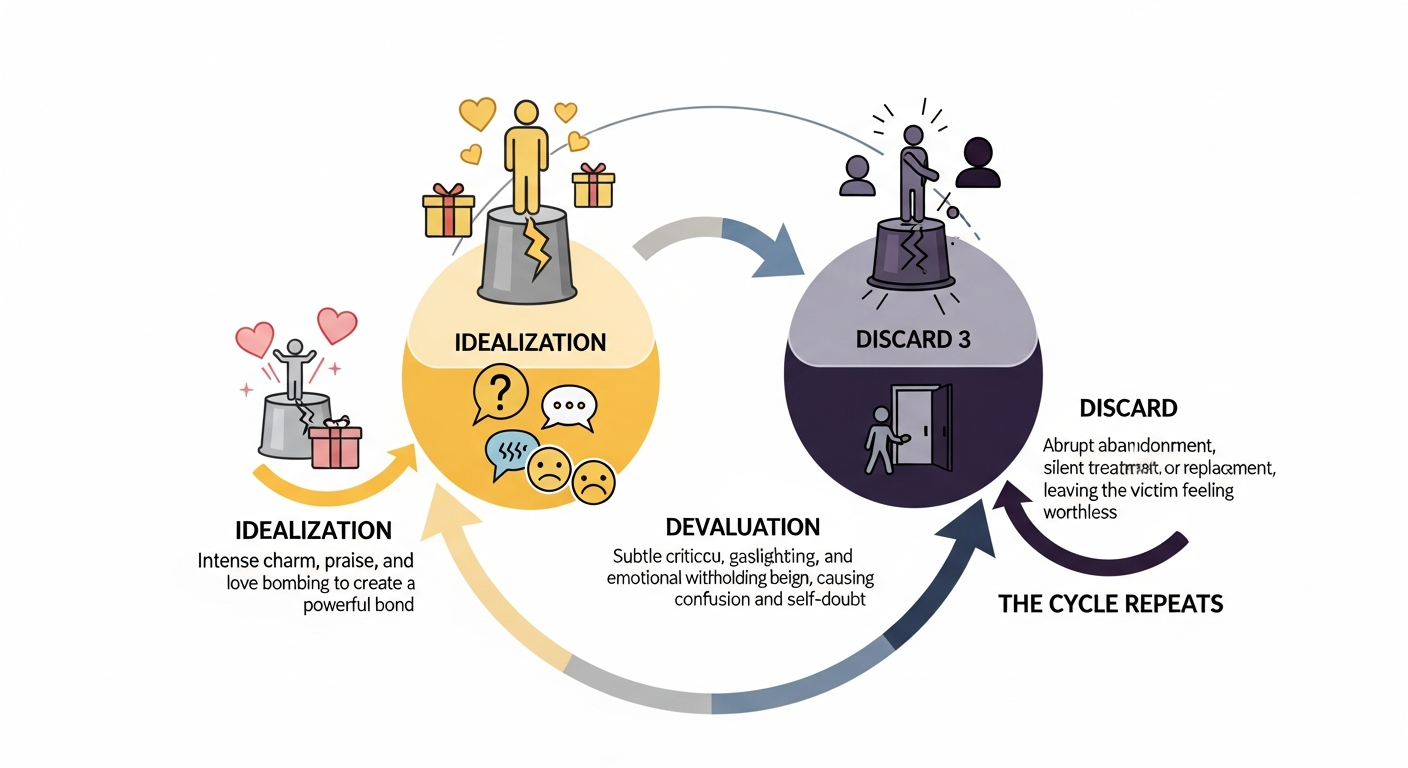
 The narcissistic abuse cycle is a predictable pattern of idealization, devaluation, and discard used to manipulate and control.
Narcissistic abuse is a form of severe emotional abuse inflicted by individuals with narcissistic traits or Narcissistic Personality Disorder (NPD). It is characterized by a distinct cycle of idealization, devaluation, and discard. The primary goal of the narcissist is to maintain control and extract "narcissistic supply"—attention, admiration, and validation—at any cost. This abuse creates a traumatic bond, making it incredibly difficult for victims to leave the relationship.
The Narcissist's Playbook: Common Tactics and Psychological Weapons
Narcissists employ a predictable set of tactics to manipulate and control their targets. Recognizing these is crucial for your healing. Key strategies include:
- Gaslighting: Systematically making you doubt your own perceptions, memory, and sanity.
- Manipulation: Using guilt, projection, and blame-shifting to control your actions and emotions.
- Love Bombing: Overwhelming you with affection and praise at the beginning of a relationship to secure your attachment.
- Devaluation: Constantly criticizing, belittling, and undermining your self-esteem.
- Isolation: Cutting you off from friends, family, and other sources of support.
- Silent Treatment: Withholding communication as a form of punishment and control.
The Profound Impact: How Abuse Rewires Your Brain and Being
Prolonged exposure to narcissistic abuse inflicts deep psychological trauma. It can lead to Complex PTSD (C-PTSD), Anxiety, Depression, and a chronic sense of worthlessness. The constant stress rewires your nervous system to be in a perpetual state of "fight or flight," impacting your physical health, concentration, and emotional regulation. The abuse erodes your ability to trust your own judgment, leaving you feeling lost and disconnected from your authentic self.
The Courageous First Steps: Disentanglement & Immediate Safety
Once you recognize the abuse, taking decisive action to create distance is paramount. This phase is often the most challenging, filled with fear and uncertainty, but it is the non-negotiable foundation upon which all future healing is built. Your safety must become your absolute priority.
Prioritizing Your Safety: Physical and Emotional Well-being
Your immediate goal is to create a safe environment. If you are in physical danger, contact a domestic violence hotline or local law enforcement. Emotional safety involves removing yourself from the source of the abuse. This may mean finding a new place to live, changing your phone number, or blocking the abuser on all platforms. Create a safety plan and share it with a trusted friend or family member.
Going No Contact or Low Contact: Severing the Abusive Ties
The most effective strategy for healing is going "No Contact." This means cutting off all forms of communication—texts, calls, emails, and social media interactions. It starves the narcissist of the supply they crave and gives you the space needed to heal without interference. If No Contact is impossible due to shared children or legal obligations, implement a "Low Contact" or "Gray Rock" strategy, keeping all communication brief, informative, and devoid of emotion.
Managing the Immediate Aftermath: Grief, Confusion, and Withdrawal
Leaving an abusive relationship triggers a complex emotional response. You will likely experience intense grief, not for the person the narcissist truly was, but for the person you thought they were and the future you imagined. The end of a trauma bond can feel like withdrawal from an addiction. Allow yourself to feel these emotions without judgment. This period of confusion and pain is a normal, albeit difficult, part of the disentanglement process.
The Healing Journey: Reclaiming Your Inner Landscape
With safety established, the deep work of internal healing begins. This is a journey of turning inward to tend to your emotional wounds, challenge the false narratives instilled by the abuser, and rediscover the person you are beneath the layers of trauma.
Processing Emotional Trauma and Wounds
The wounds from narcissistic abuse are deep. Healing requires you to process the trauma you endured. This can involve journaling to articulate your experiences, allowing yourself to feel repressed anger and sadness, and practicing self-compassion. Acknowledge the pain without letting it define you. This process is not about dwelling on the past but about releasing its hold on your present.
Rebuilding Self-Worth and Self-Esteem
Narcissists systematically dismantle their victims' self-worth. Rebuilding it is a central task of recovery. Start by challenging the negative inner critic that sounds like your abuser. Make a list of your strengths, accomplishments, and positive qualities. Engage in activities that make you feel competent and proud. Every small act of self-care and self-respect helps to reconstruct the foundation of your self-esteem.
Rediscovering Your Authentic Self and Personal Identity
Often, victims of narcissistic abuse lose touch with their own identity. Your interests, opinions, and even your style may have been molded to please the narcissist. Recovery is a time of rediscovery. Reconnect with old hobbies, explore new interests, and spend time alone to listen to your own thoughts and desires. Ask yourself: What do I want? Who am I without their influence?
Emotional Regulation and Finding Inner Peace
Trauma can leave your emotional responses feeling chaotic and overwhelming. Learning to regulate your emotions is key to finding inner peace. Practices like mindfulness, meditation, and deep breathing exercises can help calm your nervous system. By observing your emotions without being consumed by them, you regain a sense of control and stability.
Establishing and Maintaining Unbreakable Boundaries
If narcissistic abuse taught you one thing, it's that your boundaries were violated. Reclaiming your life means building a fortress of healthy, non-negotiable boundaries to protect your energy, your emotions, and your peace.
Why Boundaries Are Non-Negotiable for Recovery
Boundaries are the rules you set for how others are allowed to treat you. For survivors of narcissistic abuse, they are not suggestions; they are essential tools for survival and recovery. They teach others what you will and will not tolerate, and more importantly, they teach you that your needs matter. Strong boundaries prevent future abuse and ensure your healing is not compromised.
Practical Steps for Setting and Enforcing Healthy Boundaries
Setting boundaries requires clarity and consistency.
- Identify Your Limits: Determine what you are no longer willing to accept (e.g., disrespectful language, unsolicited advice).
- Communicate Clearly: State your boundary in a simple, direct, and firm manner. "I will not discuss this topic with you."
- Enforce Consequences: A boundary without a consequence is just a suggestion. If your boundary is crossed, follow through on the consequence you’ve set (e.g., ending the conversation, leaving the situation).
Energetic Protection and Cord-Cutting Visualizations
Beyond practical steps, many survivors find value in energetic practices. Visualization exercises can be powerful tools. Imagine a protective shield of light around you, deflecting any negative energy. Practice "cord-cutting" meditations where you visualize severing the unhealthy energetic tie that connects you to the abuser, reclaiming your power and vitality.
Building a Resilient Support System
Healing from narcissistic abuse cannot be done in isolation. The abuser worked hard to cut you off from support, and reconnecting with others is a powerful act of defiance and a critical component of your recovery.
The Power of Connecting with Others Who Understand
Connecting with other survivors of narcissistic abuse is incredibly validating. Support groups, online forums, and trusted friends who have similar experiences can provide a sense of community and understanding that is often difficult to find elsewhere. Sharing your story with people who "get it" reminds you that you are not alone and that your experience was real.
Cultivating Healthy Relationships Based on Trust and Empathy
As you heal, you will learn to build new relationships grounded in mutual respect, trust, and genuine empathy. This requires learning to trust your intuition again. Pay attention to red flags but also recognize the green flags: consistency, respect for your boundaries, and the ability to listen and care. Your capacity for empathy, once a vulnerability, can become a strength in forming deep, authentic connections.
Professional Pathways to Deeper Healing
While self-help and peer support are invaluable, the complexity of trauma from narcissistic abuse often requires professional guidance. Seeking therapy is not a sign of weakness; it is a courageous investment in your well-being.
Finding the Right Therapist: Trauma-Informed Care is Key
When seeking therapy, it is crucial to find a professional who is "trauma-informed" and has experience with narcissistic abuse. They will understand the nuances of gaslighting, manipulation, and trauma bonding. Therapeutic modalities like Eye Movement Desensitization and Reprocessing (EMDR), Somatic Experiencing, and Cognitive Behavioral Therapy (CBT) can be highly effective in processing trauma.
Specialized Support: Coaches, Mentors, and Community
In addition to therapy, specialized coaches who focus on narcissistic abuse recovery can offer targeted strategies and support. Mentors and community programs can also provide structured guidance and accountability, helping you stay focused on your healing goals and continue moving forward in your new life.
Navigating Specific Post-Abuse Challenges
The end of the relationship does not always mean the end of the narcissist's influence. Certain situations require specific strategies to protect yourself and your loved ones.
Co-Parenting with a Narcissist: Protecting Your Children
Co-parenting with a narcissist is exceptionally challenging. The focus must be on protecting your children from emotional manipulation. Use a court-documented parenting plan to minimize conflict. Keep communication strictly to logistics via email or a co-parenting app. Model healthy emotional behavior for your children and create a stable, loving home environment to counteract the chaos of the other parent.
Dealing with Post-Separation Abuse and Retaliation
Narcissists often engage in post-separation abuse, using smear campaigns, legal battles, and other forms of harassment to continue exerting control. Document everything meticulously. Keep all communication in writing. Lean on your support system and legal counsel. Remember that their retaliation is a reflection of their disordered personality, not your worth.
Conclusion
The path to healing from narcissistic abuse is a profound journey of reclamation. It is about moving from a state of survival to one of thriving. It requires you to acknowledge the depth of your wounds, actively engage in the process of rebuilding your self-worth, and fiercely protect your peace with unbreakable boundaries. You have navigated an unimaginable psychological landscape and emerged with a strength you may not yet recognize.
Your recovery is a testament to your resilience. Continue to invest in your healing through therapy and support systems. Trust the process, be patient with yourself, and celebrate every step forward. You are rewriting your story, and the next chapter is one of freedom, authenticity, and a life lived entirely on your own terms. The journey back to yourself is the most important one you will ever take.


